What We’re After
The project objective is to trace the learning of Peggy from infancy through 4 and more years.
For us that means ascribing to her internal structures developing from interactions with external things, both living and non-living, which exist in her shared space.
We view her as an agent (the child acts in species specific ways [rooted in phylogeny]) whose interest in this study is how she and her context both change as she grows and adapts to consequences of her actions. The context manifests as a duality because other agents appear both as agents and as things. We believe detailing her developmental history as a case study will illuminate the processes of her learning, and the learning of others as well.
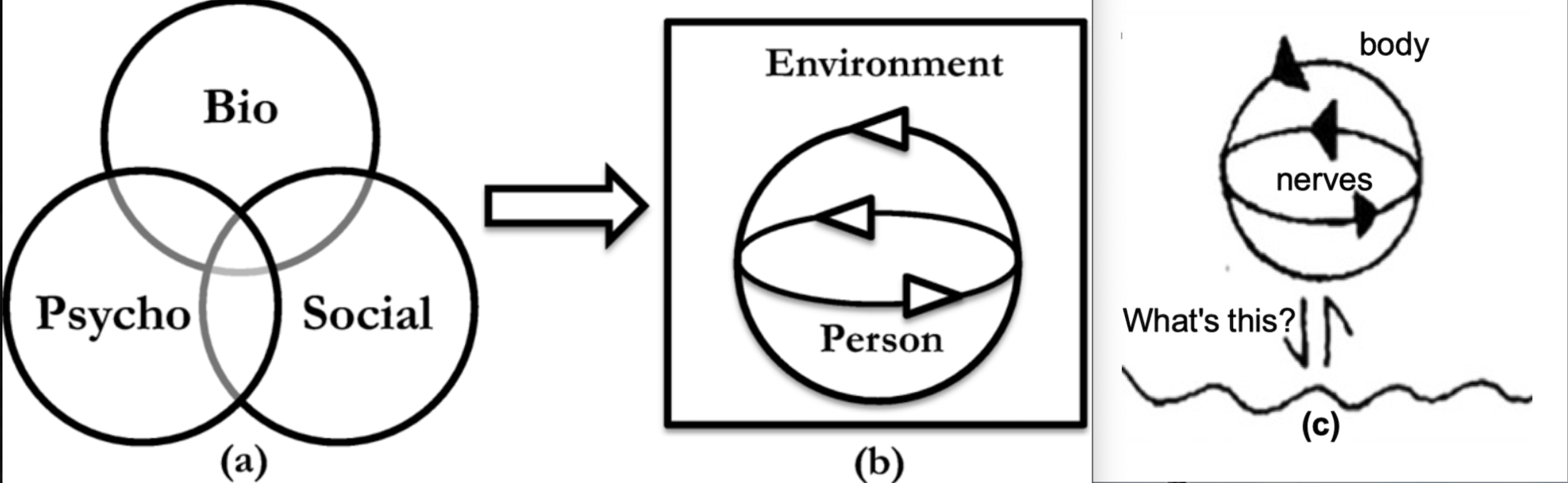
We’ve attempted to sketch the situation, following Maturana and Varela, differing – not to make a dispute, but because our foci differ. (We grant that humans act as homeostatic systems striving for equilibrium in a sea of both opportunities for action and sensations; we focus on the nature of the interactions). Like Janus, the double-faced Roman god of entries, when facing inward, homeostasis is the model. When facing outward, equilibration is the model. We are exploring the child’s development of representations through her actions. The Venn diagram of Figure (a) shows we recognize the importance of biological, social and psychology issues. In Figure (b), showing the influence of M&V, the vertical circle represented the continuous cyclical processes of life, the horizontal circle stands for a developed nervous system within a person, both forming a unity within an environment. Figure (c) shows a sensori-motor multicellular body with its nervous system of neurons and interneurons. “What’s this?” highlights the symbol indicating “structural coupling,” which I see as the suite of co-ordinations developed through evolution (phylogeny and development in the infant) and learning (ontogeny of the infant and child as she adapts through interacting with her environment).
Maturana’s focus in “The Tree of Knowledge” is a logician’s articulation and presentation of his conceptual system of the biological bases and production of knowledge through living. [endnote]
We now, with appreciation, exit the Den of the Logician, and turn from a logical to a more physical view of a creature in the world we experience. Energy is essential for life. I ask, “if that wavy-line in Figure (c) stands for the water so important to life, should it be below the life-form or above.” Below is good: radiant energy from the sun powers plankton life on the sea surface. Above is good too: water temperature gradients conduct energy from thermal vents to deep sea life forms, and ocean wide, the death of surface creatures drops their remains for digestion by creatures below. Gravity defines the first direction.
Radiant heat and thermal conduction are absorbed at the surface of a creature. The biochemistry of digestion is typically performed inside a body. Underwater creatures commonly have a mouth for food entry; they have an exit. So the underwater creature is geometrically more often a torus with nerves than a sphere. If food descends from above, then directionality is manifest by gravity. And if food is broken and dissolved into macromolecules and smaller ones for transport through the inner cell wall of a digestion portion of the torus, the steps of the process join time to energy and space in the context of life. As the downdrift of food varies from place to place and over times, movement in lateral directions becomes importantly useful and occurs by offspring generation, by mobility development or both joined in evolution. Other needs for survival, satisfied through the evolution and activity of other senses (numbering far more than five, though counts are in dispute) comprise the physical world of the living.
Unity or Duality?
Maturana and Varela, focusing on the centrality of homeostasis, argue with Figure (d) that, as structural coupling is the mechanism between the perturbing environment and a life form, a second instance of life is likewise a source of perturbations, no more, until an additional level of structural organization is created: a cogent, nicely argued position, and one I may accept someday, but for now I will proceed recognizing different kinds of interactions between Peggy and the kinds of entities she encountered. (click on figures to enlarge the images)
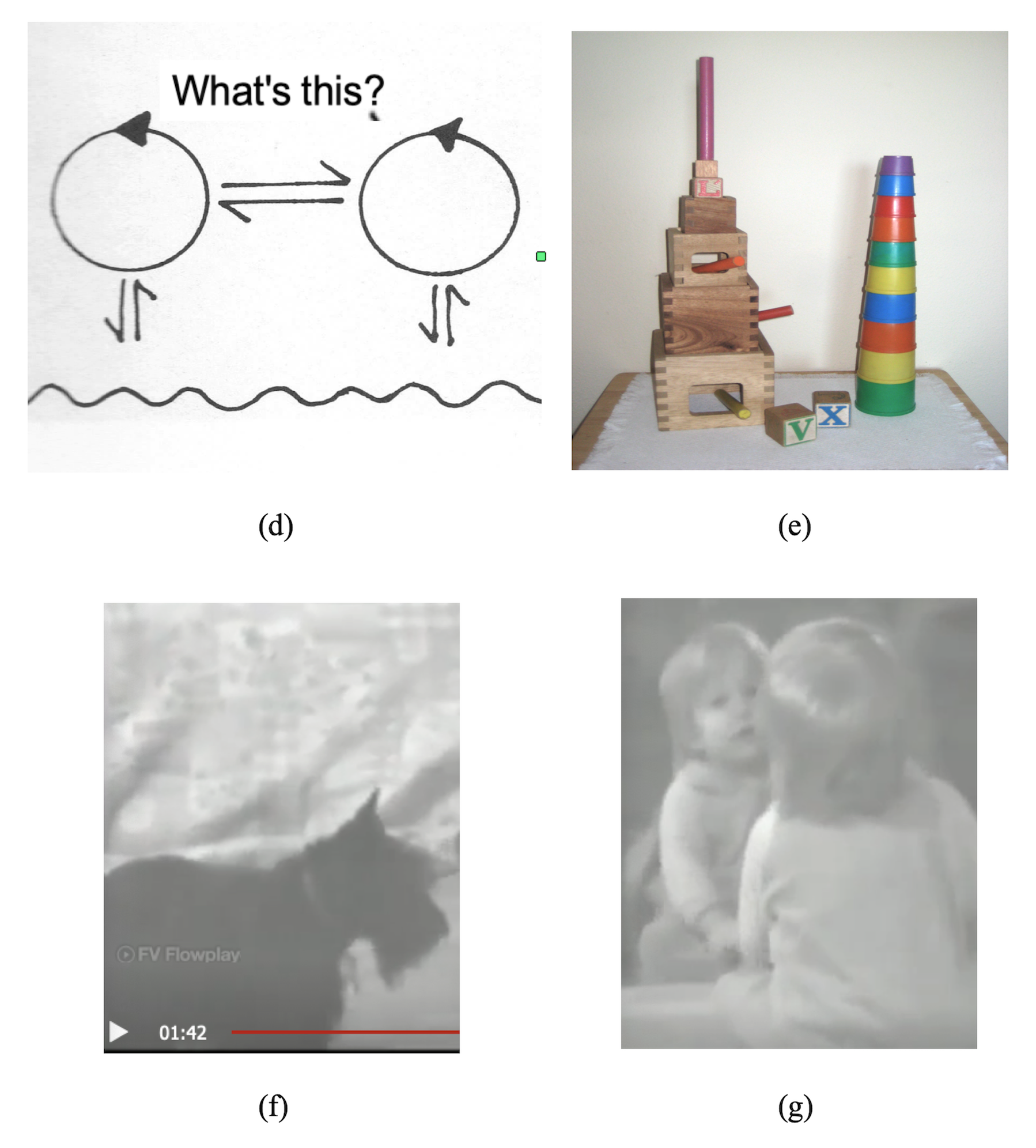
The “standard objects” of our weekly activities, Figure (f), remain still unless set in motion by an action (though they may “push back” is you try putting something too big into a small or differently shaped cavity). Scurry the Scotty, Figure (f) has a will and actions of her own, but she accepts domination by a toddler who shares food with her. Peggy’s reflection in Figure (g) is another sort of entity it will be interesting to follow. And, of course, interactions with four human family members offer a broad field for exploration through the six years during which we were able to collect materials.
We plan to track Peggy’s interactions that are most prominent in her living, to organize them into entity centered groupings and types (people objects, other), serialize them by event and recording dates into threads (as stand-alone analyses) or fibers, components of compound entities (as her play with plastics rings was a component of her eventual mastery of the “RingTower Puzzle.”) “Threads” can be seen as a root metaphor for our approach to this tangle of gathered material.
We conclude this note with an attempt to summarize the situation of the project’s recordings:
time period: from 18 weeks of Peggy’s age, for six years
location: primarily in the living room of the family home Bob built 10 years earlier (200 videos);
other sites were a carriage house in Brookline, MA (4) and a flat in Paris, FR (18)
participants: Peggy: focus. Parents: Gretchen and Bob. Siblings: Miriam and Rob. Dog: Scurry.
space: a matching loveseat and chair with solid backs were pushed in front of the raised hearth, converting the room into a large playpen, with video equipment at the room’s east wall; it was more a family room than a parlor, with the toy chest off in a corner but well visited.
The graphic sketch I have made (here omitted) proves useless because it does not focus on the aspects of Peggy’s development that are a central interest: what she knew, how it fit in her life and how it came about through her interactions with the things and agents of her everyday activities. I recommend instead a 4 minute video clip P89D4 which shows the interplay of senses, agency, demonstration of object concept mastery, the entangling of word production and action, and fun.
It even raises Montaigne’s conundrum:
“When I play with my cat, who knows if she has more fun playing with me than I do with her?”
(Quand je me joue a ma chatte, qui sais si elle passe son temps de moi, plus que je me fais d’elle?)
endnote: The Tree of Knowledge, 1988, New Science Library, Shambhala Publications, Boston and London.
What a delight to read and revisit! This is a lovely work in its systematic argument, biological knowledge, choice of examples, lucid discussion and insistence on the mental hygiene which ascription of behavior and its interpretation require.
Nonetheless, we seek to understand how learning happens as a side effect of living. We’re after the snark and believe we’re hot on its trail.
R. W. Lawler
9/23/2026
